Power
Find out how Singapore is shifting to clean energy.
Last updated on 28 September 2026
Power generation is one of the major sources of Singapore’s carbon emissions and accounts for about 40% of our emissions today. With our limited capacity to tap on alternative energy sources, we currently rely heavily on imported natural gas to power our nation.
Energy Reset: A More Environmentally Friendly Method to Power Our Nation
Singapore will harness and tap on the four switches to transform our energy supply (opens in new tab): Solar, Regional Power Grids, Emerging Low-Carbon Alternatives, and Natural Gas.
Solar
Solar is the most viable renewable energy source for Singapore in the near-term. As an indigenous source of energy, solar also contributes to the resilience and diversification of our energy mix. We have achieved over 2 gigawatt-peak (GWp) of solar deployment as of end-2025, and are pressing ahead with ambitious plans to achieve our target of 3 GWp by 2030.
The Government has launched various initiatives to promote solar deployment. Through programmes such as SolarNova (opens in new tab), SolarLand, and SolarRoof, the Government has taken the lead to deploy solar on public buildings and spaces, including HDB blocks, schools, vacant land, and reservoirs. We have also streamlined regulations to facilitate solar adoption by private building owners.
Solar’s contribution to Singapore’s energy mix is fundamentally limited by our land constraints and cloud cover. Nevertheless, the Government will continue to push the boundaries for solar deployment, including investing in R&D for next-generation high-efficiency solar panels and exploring innovative urban applications such as solar canopy structures.
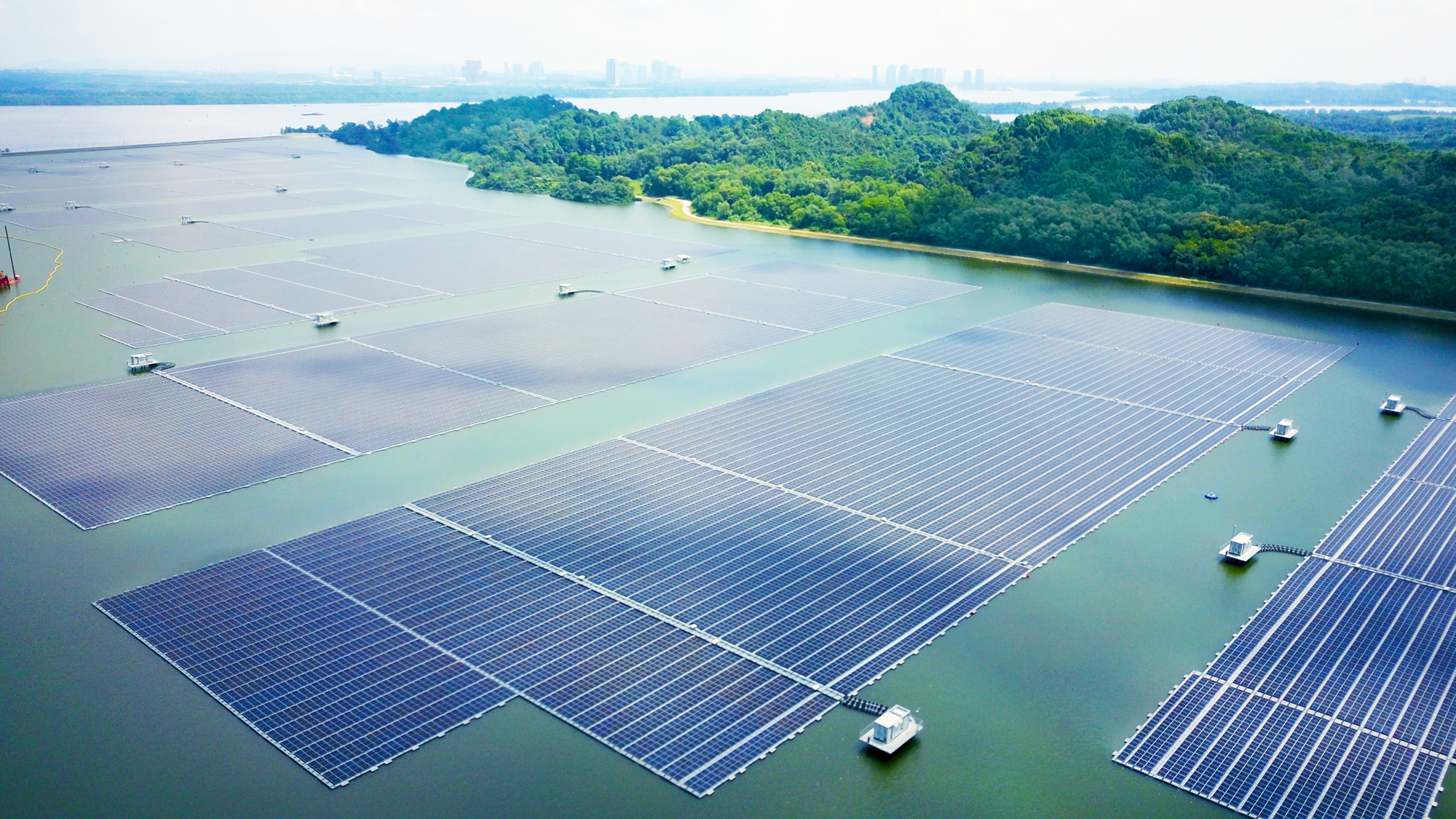
The 60 megawatt-peak floating solar photovoltaic farm at Tengeh reservoir has some 120,000 solar panels spanning across 45 hectares, or the equivalent of about 45 football fields. Image courtesy of Sembcorp Industries.
Regional Power Grids
To ensure adequate supply to meet Singapore's future energy needs, Singapore is seeking to import around 6 GW of low-carbon electricity by 2035, up from the initial target of 4 GW. This is expected to be around one-third of our energy demand then.
As a pathfinder to the ASEAN Power Grid, Singapore has begun importing renewable hydropower from the Lao People's Democratic Republic (PDR) since June 2022 (opens in new tab), using existing interconnections via Thailand and Malaysia, as part of the Lao PDR-Thailand-Malaysia-Singapore Power Integration Project (LTMS-PIP).
To further develop and refine our technical and regulatory frameworks for large-scale electricity imports, Singapore has also announced two small-scale trial imports of electricity: 100 MW from Peninsular Malaysia and 100 MW from a solar farm in Pulau Bulan, Indonesia (opens in new tab).
Emerging Low-Carbon Alternatives
Singapore is studying emerging low-carbon technologies like hydrogen, carbon capture utilisation and storage (CCUS) (opens in new tab), and advanced geothermal systems as possible paths to decarbonising our power sector. Under the Low-Carbon Energy Research (LCER) Funding Initiative (opens in new tab), we have awarded S$55 million to support 12 research, development and demonstration projects on low-carbon hydrogen and CCUS, with another S$129 million set aside for the next phase of the programme.
Low-Carbon Hydrogen
Given its potential as an alternative fuel and industrial feedstock, Singapore is also exploring low-carbon hydrogen. Although many low-carbon hydrogen technologies and supply chains are still nascent, Singapore is taking steps to prepare for hydrogen deployment. Our National Hydrogen Strategy (opens in new tab) is organised around five key thrusts:
Experimenting with the use of advanced hydrogen technologies at the cusp of commercial readiness through pathfinder projects;
Investing in research and development (R&D) to unlock key technological bottlenecks;
Pursuing international collaboration to enable supply chains for low-carbon hydrogen;
Undertaking long-term land and infrastructure planning; and
Supporting workforce training and development of our broader hydrogen economy, so that Singaporeans will be ready to capture new opportunities in the global hydrogen economy.
We will continue to monitor the economic and technological viability of deploying hydrogen as a decarbonisation pathway for Singapore.
Carbon Capture, Utilisation and Storage (CCUS)
We are also exploring possible CCUS deployment pathways. Carbon dioxide captured could be sequestered in suitable sub-surface geological formations, utilised as feedstock for synthetic fuels or as building materials through mineralisation. Singapore will continue to monitor technological and market developments, and scale up deployment as pathways become techno-economically viable.
In July 2025, EMA commissioned three power generation companies to conduct carbon capture and storage (CCS) feasibility studies. (opens in new tab) Two power sector CCS pathways are studied: (a) post-combustion carbon capture and (b) pre-combustion carbon capture. Findings from the feasibility studies will provide insights into the power sector CCS pathways, identify infrastructure requirements, and further assess the feasibility of CCS to decarbonise the power sector.
Read more about CCUS in Singapore (opens in new tab).
Natural Gas
Since 2000, Singapore has shifted away from less efficient fossil fuels and in turn increased the percentage of natural gas used in electricity generation from 19% to about 94% in 2024.
Natural gas will continue to be an important fuel for Singapore in the near future as we scale up our other switches. We will continue working with the industry to improve the energy and carbon efficiency of natural gas generation units during this transition.
Among all fossil fuels, natural gas produces the least amount of carbon emissions per unit of electricity. Singapore's fuel mix allows our emission to be much less carbon intensive than other nations that still use coal as an important part of their power generation. Singapore's Grid Emission Factor (opens in new tab) — a measure of the carbon intensity of electricity generation — has fallen from 0.409 kgCO2/kWh in 2019 to 0.402 kgCO2/kWh in 2024.
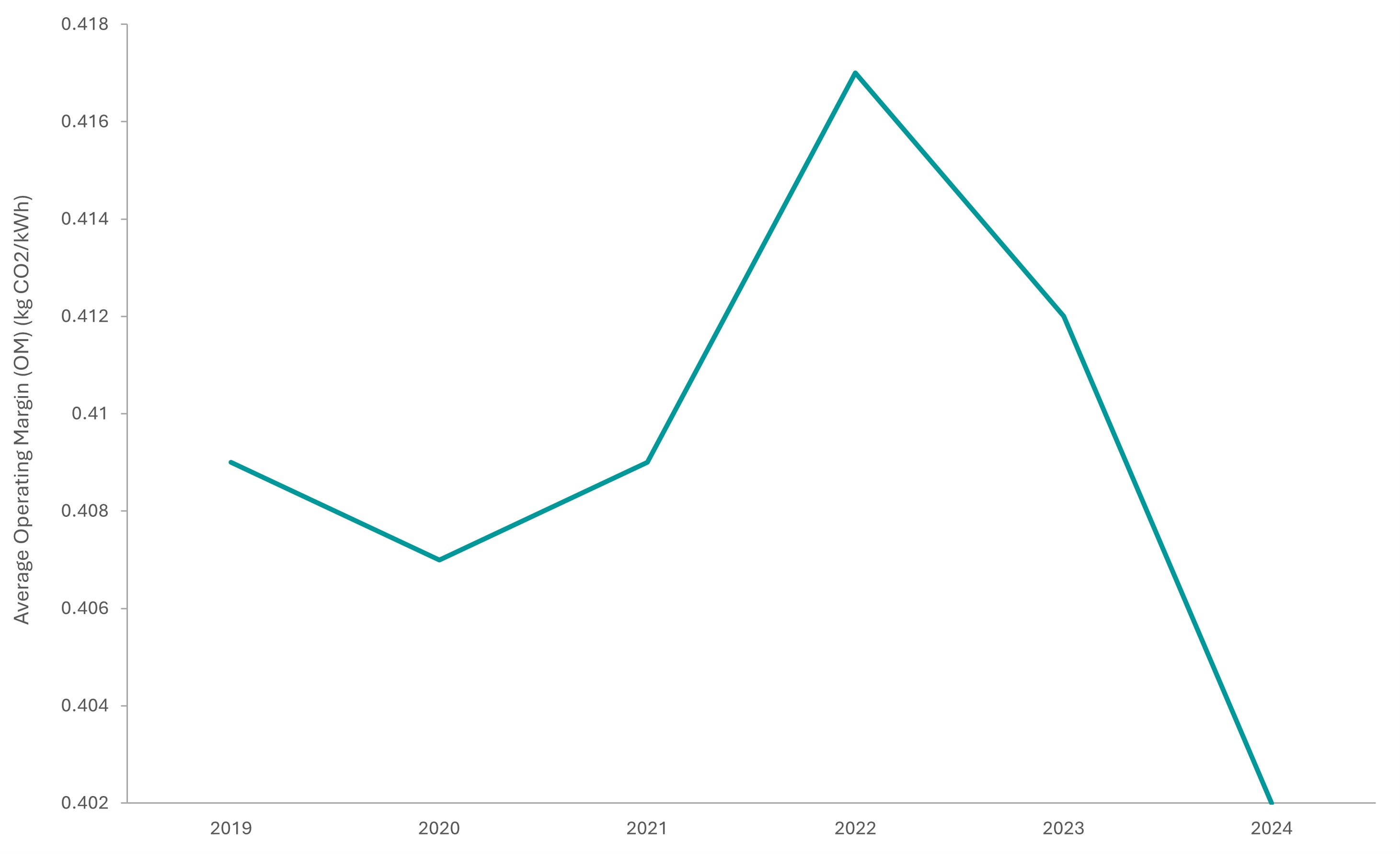
Singapore's Grid Emission Factor, 2019 to 2024.
Source: EMA