Overview
Learn how Singapore is adapting to the impacts of climate change through a resilience framework.
Last updated on 9 July 2026
Climate change affects Singapore's annual mean temperature, which has risen by 0.24°C per decade from 1984 to 2022. The recent ten years in 2010-2019 was the warmest decade on record at 27.95°C. The daily rainfall totals and frequency of days with heavier rainfall have also risen.
Additionally, the mean sea level is also projected to rise by 0.23m to 1.15m by the end of the century. This makes adaptation measures a necessity for Singapore to prepare for the effects and to increase resilience to the effects of climate change.
Singapore's Approach to Adaptation
Singapore has started making early preparations to adapt to the impact of climate change. At the same time, our understanding of climate change is continually evolving. To address the projected effects of climate change over the next 50 to 100 years, the government has introduced a resilience framework to guide our efforts in safeguarding Singapore over the long term.
Singapore's Adaptation Approach
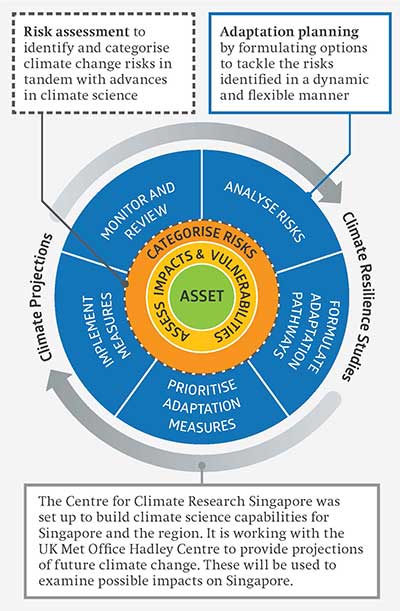
Source: Resilience Working Group
Being Flexible to Incorporate Future Findings
The Resilience Working Group (RWG) under the Inter-Ministerial Committee on Climate Change (IMCCC) studies Singapore's vulnerability to the effects of climate change and develops long-term plans that ensures the nation's resilience to future environmental changes.